






























Ocean Bill of Lading (Chinese-English Comparison)
Ocean Bill of Lading: Chinese-English Reference
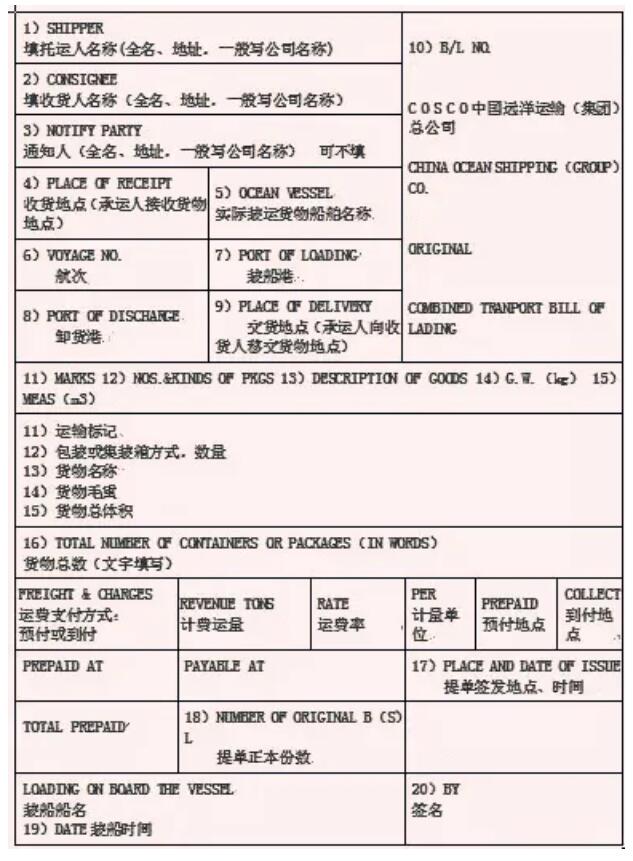
Key Instructions for Completing Ocean Bill of Lading Fields
1. Shipper:
The party entering into the contract of carriage with the carrier and entrusting the goods for shipment, i.e., the consignor. Under letter of credit (L/C) payment terms, the beneficiary is generally the shipper; under documentary collection, the principal of the collection is the shipper. Additionally, according to Article 31 of UCP 500: unless otherwise stipulated in the credit, banks will accept a transport document indicating a third party other than the beneficiary as the consignor.
2. Consignee:
The consignee field must be completed in accordance with the contract and L/C stipulations. Common methods include:
3. Notify Party:
In principle, this field must be completed strictly according to L/C stipulations. The notify party is the consignee's agent or the party to be notified for taking delivery. Upon arrival at the destination port, the carrier uses the information in this field to notify the party to arrange delivery. Therefore, the notify party on the B/L must have a detailed name and address for timely notification by the carrier or destination port. If the L/C does not specify a clear address, to maintain documentary consistency, it may be omitted on the original B/L but must be stated clearly on the copy B/L. Under documentary collection, the notify party is generally the drawee/payer.
4. Ocean Vessel:
The name of the vessel arranged by the carrier for loading the goods. For liner shipments, the voyage number (Voy. No.) is often added.
5. Port of Loading:
Fill in the actual name of the port where the goods are loaded. Under L/C terms, it must strictly comply with L/C stipulations. If the L/C states "Chinese Port," do not copy this phrase; instead, fill in the actual name of the specific Chinese port of loading.
6. Port of Discharge:
In principle, the port of discharge on the B/L under L/C must comply with L/C requirements. However, if the L/C specifies two or more ports, or uses a general term like "European Main Ports," only one specific port can be selected and its name filled in.
7. Shipping Marks (Marks & Nos):
If the L/C explicitly stipulates the marks, follow it exactly. If not stipulated, follow the agreement between buyer and seller, or as decided by the seller, ensuring consistency across all documents.
8. No. & Kind of Packages:
For bulk cargo, this field is typically filled with "In Bulk," and the total packages in words field can be left blank. The unit quantity and packaging must match the actual goods, and the total number of packages must be written out in English words in the designated field. For example, if the total is 320 CARTONS, enter this in the field, and then in the "Total Numbers of Packages in Words" field write: "Three hundred And Twenty Cartons only." If the shipment includes two or more different packaging units (e.g., cartons, iron drums), list the quantities for each packaging type separately, followed by the total packages:
9. Description of Goods:
In principle, the goods description on the B/L should comply with L/C stipulations and be consistent with the invoice and other documents. However, if the L/C lists many detailed item names, a general category term is acceptable on the B/L. For example, if exporting table knives, fruit knives, forks, and spoons, with each item's name, specification, and quantity listed separately in the L/C, but all packed in cartons, the B/L can simply state: "Cutlery ××× Cartons."
10. Gross Weight & Measurement:
Unless the L/C specifies otherwise, the B/L generally only states the total gross weight and total measurement of the goods, not the net weight or unit measurement. Weight is usually expressed in kilograms, and measurement in cubic meters.
11. Freight & Charges:
Under L/C, the freight payment terms on the B/L should be filled in as stipulated. Generally, based on the trade terms: for CIF and CFR terms, indicate "Freight Prepaid" or "Freight Paid"; for FOB terms, indicate "Freight Collect" or "Freight Payable at Destination." For charter party B/Ls, "Freight Payable as Per Charter Party" may sometimes be required. If the L/C requires the freight amount to be stated, fill in the actual freight paid.
12. Place and Date of Issue:
The place of issue for a bill of lading is generally the port where the goods are shipped, and the date should comply with the shipment period required by the letter of credit, usually being earlier than or the same as the shipment date. Sometimes, due to inaccurate sailing schedules, delays, or delays caused by the shipper, the actual shipping date may be later than the stipulated shipment period. In such cases, to comply with the letter of credit requirements and ensure document consistency, the shipper may request the shipping company to issue a bill of lading with an earlier date or one that matches the shipment period in exchange for a letter of indemnity. This is known as an Ante-Dated B/L. Additionally, sometimes when the goods have not yet been loaded or the vessel has not sailed, the shipper, in order to obtain the full set of documents early for negotiation, may request the shipping company to issue an on-board bill of lading, which is called an Advanced B/L. These two practices should be avoided, as any issues arising or detection by the buyer could result in significant economic losses and adverse effects.
13. Signed for the Carrier:
The bill of lading must be signed by the carrier or its agent to be valid. If the letter of credit requires a handwritten signature, this must also be complied with. Regarding the question of who may validly sign an ocean bill of lading, UCP500 provides a new supplementary provision in Article 23(a)(1), stating that the signatory may be the carrier or a named agent or representative acting for the carrier, or the master or a named agent or representative acting for the master.
14. Number of Original B/L:
Under the letter of credit payment method, the number of original bills of lading to be issued is generally specified clearly. Therefore, the required number must be issued strictly in accordance with the letter of credit. For example, if the letter of credit states: "Full set 3/3 Original clean on board ocean Bill of Lading…," this indicates that three original bills of lading are to be issued, and all three originals must be presented to the bank for negotiation. If the number is not specified in the bill of lading clause but is indicated elsewhere, such as: "…available by beneficiary's draft at sight drawn on us and accompanied by the following documents in duplicate," this means all documents required under the credit, including the bill of lading, are to be submitted in duplicate. Another example is when the letter of credit states: "Full set of clean on board Bill of Lading issued…" This does not specify a number but refers to a "full set." According to UCP500 Article 23(a)(4), this includes "a sole original bill of lading or, if issued in more than one original, the full set as so issued." Therefore, for such stipulations, the number depends on the actual number of originals issued by the shipping company.
15. B/L Number:
Generally located in the upper right corner of the bill of lading, this is the reference number assigned by the carrier for the goods shipped by the shipper, facilitating work communication and verification. Other documents, such as insurance policies and shipping advice, often require the bill of lading number to be indicated.