





























NEWS

HOME ꄲ NEWS ꄲ Freight rate trends diverge! Europe and US routes continue to decline, while rates on multiple Southeast Asia and Middle East routes rebound sharply.

Freight rate trends diverge! Europe and US routes continue to decline, while rates on multiple Southeast Asia and Middle East routes rebound sharply.

Published:2026-10-21 02:35
넶Views:6


Freight rates on European and American routes continued to decline, though the drop narrowed and rates are stabilizing. Rates on Middle East and Southeast Asia routes continued to rebound sharply, especially on the Thailand-Vietnam route, where carriers arranged a large number of blank sailings, leading to tight space supply and a sharp rate rebound. The freight rate on the Thailand-Vietnam route surged 193.8% compared to last week.

Shanghai Shipping Exchange The latest published container freight index SCFI reached 1778.69 points, down 35.31 points week-on-week, with the decline narrowing to 1.99%. Although this marks the 18th consecutive week of decline, freight rates are gradually stabilizing. On the Persian Gulf route, rates surged nearly 60% over two weeks, driven by the approaching Qatar World Cup and the withdrawal of one service by an alliance.
A major freight forwarding company anticipates that freight rates may rebound before the Lunar New Year. A senior executive at the company noted that rates are currently stabilizing, primarily due to a modest increase in cargo volume. However, the growth is still insufficient to trigger a rate rebound on the main Europe and U.S. routes, especially given severe inflation in countries like the UK. Yet, two key factors driving inflation— Freight rates have already dropped significantly, and now the focus is on oil prices. The U.S. has announced plans to release strategic petroleum reserves. If oil prices can also be brought down, commodity prices will follow suit, thereby helping to resolve the inflation issue. Therefore, there is still a chance for freight rates to rebound before the Lunar New Year, and we may see a small peak season for market rates.
Europe Route:Immense inflationary pressure has forced the European Central Bank to adopt tightening policies, further slowing the already sluggish European economic growth. Recent manufacturing data has fallen below the boom-bust line. With winter approaching, the ongoing Russia-Ukraine conflict continues to test Europe with an energy crisis, worsening the already historically high inflation and posing a risk of recession for the future economy. Transport demand remains weak after the National Day holiday, and market freight rates continue their downward trend. The SCFI Shanghai-to-Europe rate per container (20-foot) is $2,379, down $202 week-on-week, a drop of 7.83%; the Mediterranean route rate per container is $2,568, down $179 week-on-week, a drop of 6.52%.
North America Route:
U.S. retail sales remain sluggish, with consumers growing increasingly cautious about non-essential purchases amid severe inflationary pressures. The slowdown in consumption and employment, coupled with the Federal Reserve's aggressive interest rate hikes to curb inflation, continues to heighten the risk of the U.S. economy slipping into stagflation. The post-holiday transportation market has been slow to recover, with lackluster shipping demand leading to an unstable supply-demand balance. Market freight rates continue their downward adjustment, though the pace of decline has begun to ease. The rate from Shanghai to the U.S. West Coast stands at USD 2,029 per 40-foot container (FEU), down USD 68 week-on-week, a decrease of 3.24%; to the U.S. East Coast, the rate is USD 5,639 per FEU, down USD 177 week-on-week, a decrease of 5.53%.
South America Route (Santos) rate is USD 5,059 per container, down USD 61 week-on-week, a decrease of 1.19%;
Persian Gulf Route, post-holiday cargo volumes have remained generally stable. Earlier blank sailings of some capacity improved the supply-demand balance, and spot booking rates continued to rebound this week. The rate stands at USD 1,451 per container, up USD 280 week-on-week, an increase of 23.91%;
Southeast Asia Route(Singapore) freight rate per container is USD 352, up by USD 3 week-on-week, an increase of 0.86%.

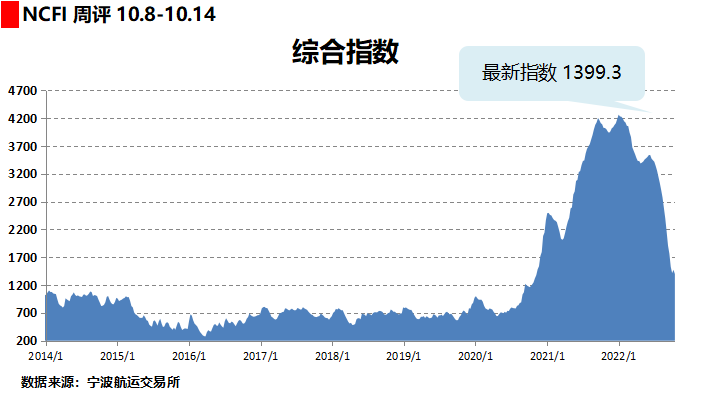
Ningbo Shipping ExchangeThe latest Ningbo Containerized Freight Index (NCFI) closed at 1399.3 points, down 5.1% from last week. Among the 21 routes, 8 routes saw freight rate index increases, while 13 routes saw decreases. Among the major ports along the "Maritime Silk Road," 10 ports recorded freight rate index increases
, with six port freight rate indices declining.


★ Key Route Index Details as Follows ★


  • Europe & Mediterranean Routes: Transport demand remains sluggish, with the routes still in a state of oversupply, leading to a significant drop in market booking rates. The Europe route freight index stands at 1624.1 points, down 18.4% from last week; the East Mediterranean route index is 1568.2 points, down 10.9% from last week; the West Mediterranean route index is 1856.0 points, down 7.6% from last week.
  • North America Routes: The supply-demand relationship shows no improvement, with market booking rates on both the US East and West Coast routes continuing to decline. The US West Coast freight rate has fallen below USD 2,000/FEU. The US East Coast route index is 1892.9 points, down 5.0% from last week; the US West Coast route index is 1090.5 points, down 9.4% from last week.
  • Middle East Route: Affected by blank sailings and delays, the number of vessels in normal operation on the Middle East route is limited. Tight space availability has led to a continuous and significant rise in spot market booking rates. The Middle East Route Index stands at 1160.4 points, up 34.6% from last week.

In addition, the following routes are experiencing significant market fluctuations:

Thailand-Vietnam Route: Shipping lines have arranged a large number of blank sailings, leading to tight space supply and a sharp rebound in freight rates. The Thailand-Vietnam Route Freight Index is 654.1 points, up 193.8% from last week.

★ Major Port Freight Index Changes ★

The changes in the freight indices for major ports along the Maritime Silk Road are as follows:

ASEAN Region: This week, freight rate indices rose at 5 ports and fell at 1 port.

  • Ningbo–Singapore (Singapore) freight rate index increased 12.5% month-on-month;
  • Ningbo–Port Klang (Malaysia) freight rate index increased 31.9% month-on-month;
  • Ningbo–Ho Chi Minh (Vietnam) freight rate index increased 232.7% month-on-month;
  • Ningbo–Bangkok (Thailand) freight rate index increased 182.8% month-on-month;
  • Ningbo–Laem Chabang (Thailand) freight rate index increased 204.9% month-on-month;
  • Ningbo–Manila (Philippines) freight rate index decreased 0.4% month-on-month.

Europe Region:Ningbo—Constanta (Romania) freight index decreased13.0% month-on-month.
South Asia Region:This week, freight indices for a total of 2 ports increased.
  • Ningbo—Nhava Sheva (India) freight index increased43.8% month-on-month;

  • Ningbo—Pipavav (India) freight index increased57.3% month-on-month.

West Asia Region:This week, freight indices for a total of 2 ports increased, while indices for 3 ports decreased.

Ningbo—Istanbul (Turkey) freight index decreased10.9% month-on-month;
Ningbo—Aqaba (Jordan) freight index decreased 3.0% month-on-month;
Ningbo—Jeddah (Saudi Arabia) freight index decreased 4.7% month-on-month;
Ningbo—Dammam (Saudi Arabia) freight index increased 31.4% month-on-month;

Ningbo—Dubai (UAE) freight index increased 35.9% month-on-month.
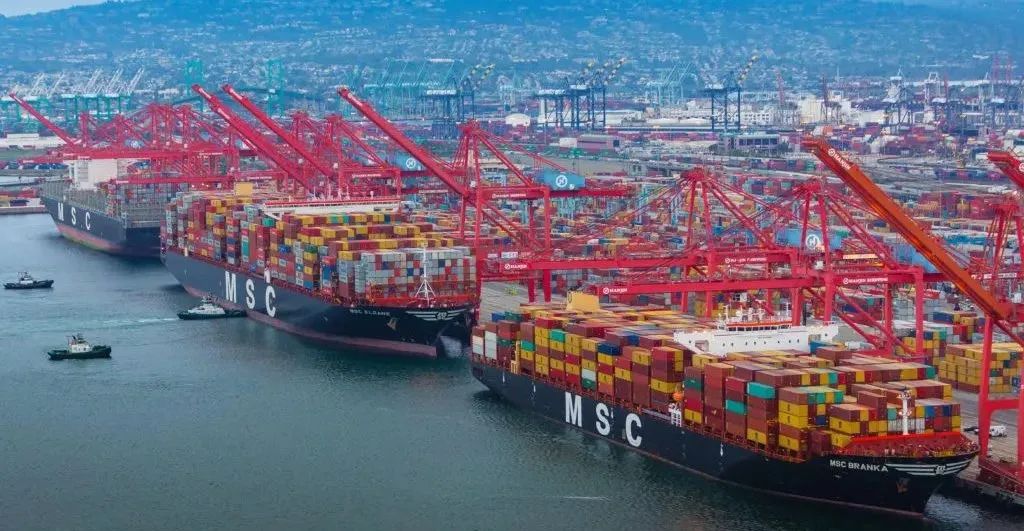
Alphaliner forecasts that nearly 2.4 million TEU of new capacity will be delivered and put into operation next year, more than double the 1.1 million TEU recorded in the same period last year. In 2024, new capacity is expected to reach an even higher 2.8 million TEU, intensifying market concerns over overcapacity. Nearly 30% of this capacity will be dual-fuel vessels, estimated to be mainly used for fleet renewal to comply with new environmental regulations taking effect next year.

 
Analysts note that current freight rate levels on Europe and US routes remain above cost, allowing major container shipping companies to remain profitable. However, many container lines that chartered vessels at high rates or operate smaller ships may face a turning point toward losses, especially on the US West Coast route.
On the other hand, the three major shipping alliances also have sufficient capacity to regulate supply. The world's top ten liner companies control 85% of market capacity and can further manage supply through blank sailings and service suspensions. In response to the significant drop in freight demand from the Far East to North America and declining rates, the two largest container shipping giants, MSC and Maersk, have already announced service suspensions on certain routes.
 
Aopak International Official Website:

www.opcargo.com


Ps: This article is sourced from Cangnayun. Please be sure to credit the source when reprinting.