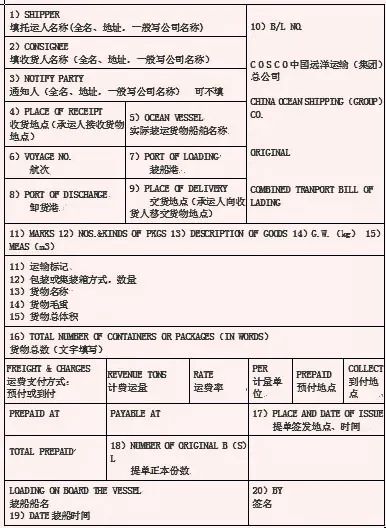
Instructions for Completing Key Fields on the Ocean Bill of Lading
1. Shipper: This is the party that enters into the contract of carriage with the carrier and entrusts the goods for shipment, i.e., the consignor. Under a letter of credit payment method, the beneficiary is generally listed as the shipper; for documentary collections, the principal of the collection is the shipper. Additionally, according to Article 31 of UCP 500: Unless otherwise stipulated in the credit, banks will accept a transport document indicating a third party other than the beneficiary of the credit as the consignor.
2. Consignee: The consignee must be filled in according to the contract and letter of credit requirements. Common methods of completion include the following:
(1) Straight Consignment: Enter the specific company or enterprise name directly in the consignee field. This type of bill of lading is non-negotiable and cannot be transferred by endorsement; goods must be released to the named consignee or as transferred by the consignee.
(2) Bearer Consignment: Leave the consignee field blank or fill in "To Bearer". Under this method, the carrier delivers the goods to the holder of the bill of lading; anyone holding the bill of lading can take delivery.
(3) Order Consignment: Order consignees are further divided into bearer order and named order.
A bearer bill of lading is one where the consignee field is filled in as “To Bearer,” also known as a blank-endorsed B/L. For this type of B/L, the shipper must endorse the back of the bill before it can be transferred. Endorsement is further divided into named endorsement and blank endorsement. The former involves writing “Deliver to ×××” or “Endorsed to ×××” on the back of the B/L, followed by the shipper’s signature; the latter requires only the shipper’s signature on the back without any additional notation. After a named endorsement, title to the goods belongs to the named party, and that party may not further endorse and transfer it to another person. With a blank endorsement, title to the goods belongs to the holder of the B/L.
\n\nAn order bill of lading is one where the consignee field is filled in as “To Order of Shipper”; in this case, the shipper must endorse the back of the B/L before sending the documents. Other variations include “To Order of Applicant,” as stipulated in the L/C, where the consignee field is filled in as “To Order of ××× Co”; and “To Order of Issuing Bank,” as stipulated in the L/C, where it is filled in as “To Order of ××× Bank.”
\n\nIn actual business practice, order B/Ls are mostly used under L/C transactions. For collection transactions, bearer order B/Ls are also commonly used. If a collecting bank order B/L is to be used, prior consent from the collecting bank must be obtained. This is because, according to Article 10(a) of URC522, goods should not be consigned directly to a bank, nor to a bank’s nominee, without the bank’s prior agreement. If goods are consigned directly to a bank or to a bank’s nominee without prior consent, and the bank is then expected to release the goods to the payer upon payment or acceptance, the bank has no obligation to take delivery of the goods, and the risk and responsibility for the goods remain with the shipper.\n\n
\n\n3. Notify Party: In principle, this field must be completed strictly in accordance with the L/C requirements. The notify party is the agent of the consignee or the party taking delivery. Upon arrival at the destination port, the carrier uses the information in this field to notify the relevant party to arrange cargo pickup. Therefore, the notify party on the B/L must include a detailed name and address so the carrier or destination port can promptly notify them. If the L/C does not specify a clear address, to maintain documentary consistency, it may be omitted on the original B/L but must be clearly stated on the copy B/L. Under collection transactions, the notify party is generally the drawee/payer of the collection.\n\n4. Ocean Vessel: This refers to the name of the vessel on which the carrier loads the cargo. For liner shipments, the voyage number (Voy. No.) is often added.\n\n5. Port of Loading: Enter the name of the port where the goods are actually loaded. Under L/C transactions, this must comply with the L/C terms and requirements. If the L/C states “Chinese Port,” do not copy this phrase verbatim; instead, enter the actual name of the specific Chinese port where loading takes place.\n\n6. Port of Discharge: In principle, the port of discharge on the B/L under an L/C must be completed as stipulated in the L/C. However, if the L/C specifies two or more ports, or uses a general term such as “European Main Ports,” only one port may be selected or the specific port of discharge name must be clearly stated.\n\nIf the L/C stipulates “In Transit to ×××” after the port of discharge, this should only be added in the shipper’s declaration box on the B/L or in the blank space below the shipping marks. In particular, if our responsibility only covers up to the port of discharge and does not include onward transit, this notation must not be added after the port of discharge, to clarify that the seller’s responsibility ends at the port of discharge and any further transit to another destination is the buyer’s responsibility.\n\nAdditionally, for exports to O.C.P. (Overland Common Points) destinations in the United States and Canada, “O.C.P. ×××” is often added after the port of discharge. For example, if the L/C states “Los Angeles O.C.P. Chicago,” the destination port on the B/L can be filled in as “Los Angeles O.C.P.”; if the final city name is required, “O.C.P. Chicago” can be noted in the blank space on the B/L or below the shipping marks, so the forwarding company can arrange transit to Chicago.\n\n7. Shipping Marks / Marks & Nos: If the L/C provides clear instructions, complete this field accordingly; if the L/C does not specify, follow the agreement between the buyer and seller, or as determined by the seller, ensuring consistency across all documents.
\n\n8. No. & Kind of Packages:
For general bulk cargo, this field should only be filled in with "In Bulk", and the capital letters package field may be left blank. The unit quantity and packaging must correspond to the actual goods, and the total quantity in English capital letters should be filled in the total packages in words field. For example, if the total number of packages is 320 CARTONS, fill this in under the corresponding field, and then in the total packages in words field (Total numbers of Packages in Words) fill in: Three hundred And Twenty Cartons only. If the goods include two or more different packaging units (such as cartons, iron drums), the quantities for each different packaging unit should be listed separately, and then the total number of packages should be indicated:
\n\n300 Cartons
\n\n400 Iron drums
\n\n\n\n9. Description of Goods: In principle, the description of goods on the bill of lading should be filled in according to the letter of credit and be consistent with other documents such as the invoice. However, if the letter of credit lists many item names, the bill of lading allows the use of a general category term to describe the goods. For example, if the export goods include dinner knives, fruit knives, dinner forks, dinner spoons, etc., and the letter of credit lists each item name, specification, and quantity separately, but all are packed in cartons, the bill of lading can simply state: Cutlery ××× Cartons.\n\n10. Gross Weight & Measurement: Unless otherwise specified in the letter of credit, the bill of lading generally only shows the total gross weight and total measurement of the goods, not the net weight or unit measurement. Generally, weight is expressed in kilograms and measurement in cubic meters.\n\n\n\n\n\n11. Freight & Charges: For bills of lading under a letter of credit, the freight payment details should be filled in as stipulated. Generally, based on the trade terms, there are two types: under CIF and CFR terms, indicate "Freight Prepaid" or "Freight Paid"; under FOB terms, fill in "Freight Collect" or "Freight Payable at Destination". For charter party bills of lading, it is sometimes required to fill in: "Freight Payable as Per Charter Party". Sometimes the letter of credit also requires the freight amount to be indicated; fill in the actual freight payment amount accordingly.\n\n12. Place and Date of Issue: The place of issue of the bill of lading is generally at the port of loading, and the date should comply with the shipment period required by the letter of credit, generally being on or before the latest shipment date. Sometimes, due to inaccurate sailing schedules, delays, or delays caused by the shipper, the actual shipment date may be later than the stipulated shipment period. To comply with the letter of credit and ensure documentary consistency, the shipper may request the shipping company to issue a bill of lading with an earlier date matching the shipment period against a letter of indemnity; this is known as an ante-dated B/L. Additionally, sometimes before the goods are loaded or the vessel has sailed, the shipper, in order to obtain the full set of documents early for negotiation, may request the shipping company to issue an on-board bill of lading, i.e., an advanced B/L. These two situations should be avoided, as problems or detection by the buyer can cause significant economic losses and adverse effects.\n\n13. Signed for the Carrier: The bill of lading must be signed by the carrier or its agent to be valid. If the letter of credit requires a handwritten signature, this must also be complied with. Regarding who can validly sign an ocean bill of lading, UCP500 provides a new supplementary provision, i.e., Article 23 a (1) stipulates that the signatory can be the carrier or a named agent for or on behalf of the carrier, or the master or a named agent for or on behalf of the master.\n\n14. No. of Originals B/L: Under the letter of credit payment method, the number of original bills of lading to be issued is generally clearly specified. Therefore, the required number of copies must be issued exactly as stipulated in the letter of credit. For example, if the letter of credit states: "Full set 3/3 Original clean on board ocean Bill of Lading...", this indicates that three original bills of lading are issued, and all three originals must be presented to the bank for negotiation. If the number of copies is not specified in the bill of lading clause but indicated elsewhere, such as: "...available by beneficiary's draft at sight drawn on us and accompanied by the following documents in duplicate", this means all documents required by the letter of credit, including the bill of lading, are to be submitted in duplicate. Another example: if the letter of credit states: "Full set of clean on board Bill of Lading issued...", this does not specify a number but refers to a "full set". According to UCP500 Article 23 a (4): "includes a sole original bill of lading or, if issued in more than one original, the full set as so issued." Therefore, for such stipulations, the actual number of originals issued by the shipping company determines compliance.\n\n15. B/L NO:
Generally located in the upper right corner of the Bill of Lading, this is the reference number assigned by the carrier to the goods shipped by the shipper for ease of communication and verification. Other documents, such as insurance policies and shipping notices, often also require the Bill of Lading number to be indicated.
\n\nIn addition to the front-side contents mentioned above, the reverse side of an ocean Bill of Lading typically contains the Terms and Conditions of Shipment mutually agreed upon by the shipper and the carrier. In theory, these should be matters agreed upon by both parties, but in practice, they are unilaterally printed by the carrier, leaving the shipper little opportunity for modification. This is why the Bill of Lading is considered evidence of the contract of carriage between the two parties, rather than the contract of carriage itself. As the formats of Bills of Lading vary among shipping companies in different countries, the provisions and content of their terms also differ. The content is extensive, covering definitions of the shipper and carrier, carrier liability clauses, freight and other charges clauses, limits of liability, general average, and more. Although extensive, the content is largely similar with minor differences and can be categorized. Generally, the paramount clause will specify the applicable international convention (such as the Hague Rules, Visby Rules, and Hamburg Rules) to serve as a basis in the event of a dispute.\n\n\n